Engineering Thermoplastic

Nylon

CNC Machined Nylon Parts — Durable, Wear-Resistant Components for Mechanical Applications
Nylon

At a glance

Processes

CNC Mill
CNC Lathe

Lead Time

As fast as 3 days

Colors

Neutral (slightly translucent), black

Tolerance

With drawing: as low as +/- 0.005 mm
No drawing: ISO 2768 medium

Price

$

Applications

Gears and sliders, large parts, general-purpose, wear & heat-resistance applications

About the Material

Nylon 6/6 is the most commonly used of the Nylon family of plastics. It enjoys relatively high chemical and heat resistance, and is stiff enough to retain its shape, but tough enough not to permanently deform under load.

Two of the most notable use cases for Nylon are in medical devices and electronics insulation, notably screws and spacers for panel mounted circuit boards.

Glass-filled Nylon boasts many great properties such as high rigidity, strength, hardness, toughness and dimensional stability. This material may be used in assemblies requiring mechanical damping or electrical insulation. Common applications include electrical housings, washers, medical devices and aerospace parts.

Resilience

Extreme Toughness Icon

Damping

Extreme Toughness Icon

Material Properties

Nylon 6/6

Tensile Strength

11,200 PSI

Elongation at Break

50%

Hardness

Rockwell R110

Density

1.13 g/㎤
0.04 lbs / cu. in.

Maximum Temp

185° F

McMaster Part Number

8540K323

Nylon (30% Glass-Filled)

Tensile Strength

13,500 PSI

Elongation at Break

3%

Hardness

Rockwell M88

Density

1.13 g/㎤
0.04 lbs / cu. in.

Maximum Temp

230° F

McMaster Part Number

1473t23

Material Finish

Nylon comes in neutral and black colors. Neutral has a milky-white finish and is slightly translucent.

Design Recommendations

Min Wall Thickness

0.5 mm

Min End Mill Size

0.8 mm (0.03 in)

Min Drill Size

0.5 mm (0.02 in)

Max Part Size (xyz, mill)

1200 x 500 x 152 mm [x,y,z] (mill)
152 x 394 mm [d,h] (lathe)

Undercuts

Square profile, full radius, dovetail profiles

Radii : Depth

Depth must not exceed 12x drill bit diameter.
For end mills, depth must not exceed 10x tool diameter.
Cost Saving Tip

Cost Saving Tip

To reduce costs, limit the number of part setups, the number of inspection dimensions or tight tolerances, and deep pockets with small radii.

You Might also be Interested in

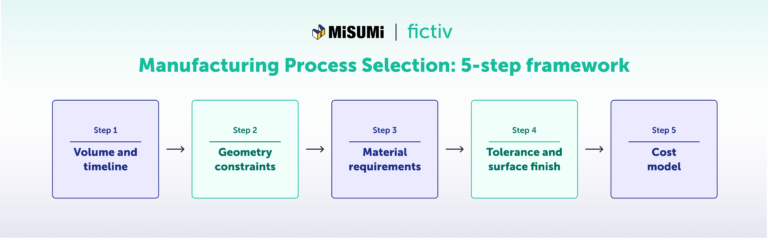
Header image: ‘Manufacturing Process Selection: 5-step framework’ with five connected steps: Step 1 Volume and timeline, Step 2 Geometry constraints, Step 3 Material requirements, Step 4 Tolerance and surface finish, Step 5 Cost model.

Manufacturing Process Selection: A Guide to Choosing the Right Production Methods

The manufacturing process you select impacts part cost, lead time, achievable tolerances, material options, and how easily you can iterate…

Learn more >
Left-aligned article header: 'The Impact of AI in Mechanical Engineering' with subtitle on a dark background; brand 'fictiv' logo visible. Right side shows a teal, high-tech schematic with an AI core and connected nodes.

The Impact of AI in Mechanical Engineering

Artificial Intelligence is no longer on the horizon for mechanical engineers—it’s already on our desktops, inside our CAD tools, and…

Learn more >